
Best RC crawler UK 2026 — tested 1:10 and 1:24 picks
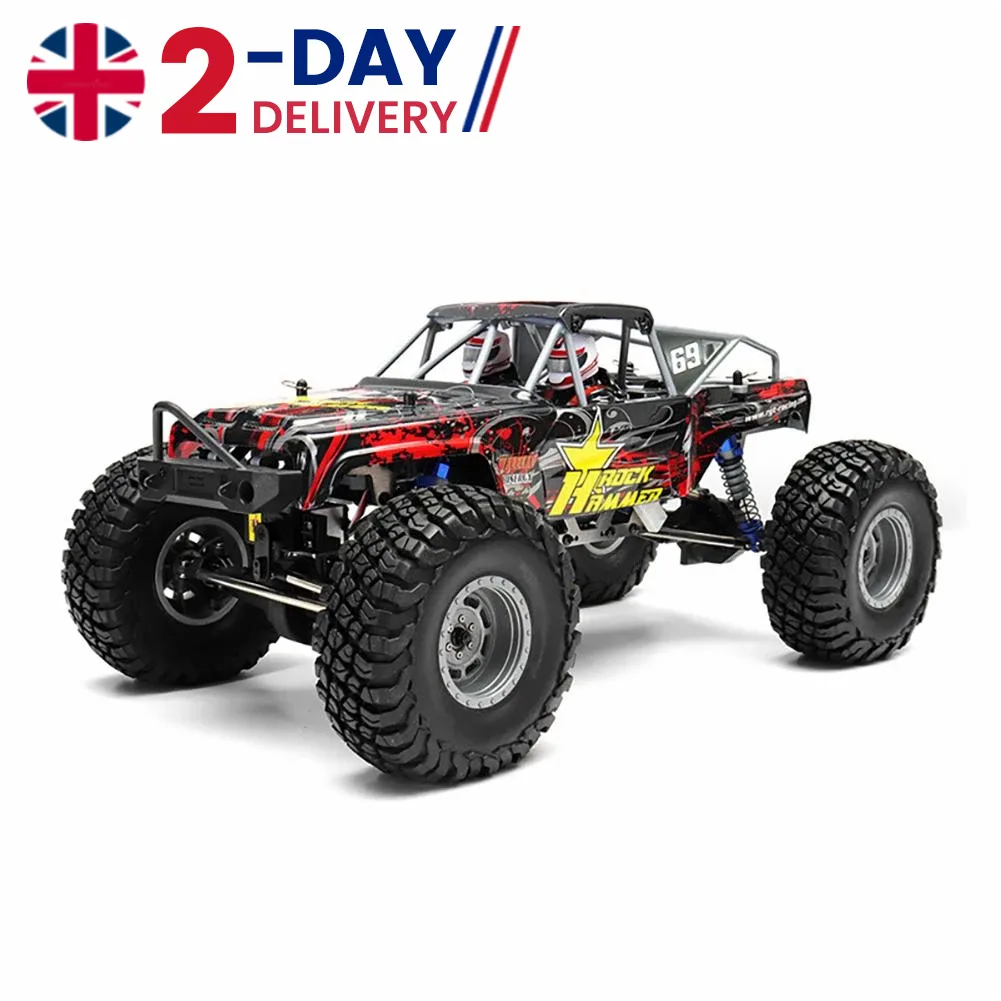
RC crawling is the discipline that rewards patience. Where buggies and truggies live for jumps and speed, a crawler is built for one thing: getting over things that would stop any other RC car. Rocks, logs, tree roots, garden furniture, staircases — if it’s vertical, a good crawler has a chance. This guide is for anyone buying their first serious crawler in 2026, with six models we currently stock and ship across the UK.
What makes a crawler different?
Three things distinguish a crawler from a regular RC car:
Low gearing
Crawlers are geared to produce torque, not speed. Top speed is typically 5-15 mph. What you trade away on the straight, you gain when climbing — a crawler will hold its position on a 45-degree slope while a buggy would just spin its wheels and slide off.
High-traction tyres
Crawler tyres are soft rubber with aggressive tread patterns and fitted with foam inserts that hold their shape under load. On rock and dirt, they deform to conform with the surface, maximising contact area. Run them on carpet and they’ll last for years; run them on tarmac and they wear fast.
Articulating suspension
Most crawlers have solid axles with long-travel shocks and, on higher-end models, panhard bars and sway-bar options. The goal is keeping all four wheels on the ground regardless of terrain angle. When one wheel lifts, a crawler’s suspension cycles far enough to keep the other three working.
Put those three together and you have a vehicle that prioritises grip and articulation over acceleration and top speed. Driving one rewards slow throttle inputs and precise line selection — it’s closer to driving a real 4×4 off-road than any other RC discipline.
Scales to consider
Crawlers are most commonly sold in 1:10 and 1:24 scale, with 1:18 and 1:8 as less common options.
- 1:10 — the mainstream scale. Biggest parts supply, widest body selection, best for outdoor crawling on real rocks and logs. Entry around £150 for RTRs.
- 1:24 mini — the indoor crawler scale. Designed for tabletop courses, books-and-cushions obstacle layouts, and small gardens. Entry around £60.
- 1:18 micro — a niche between the two, useful for tight outdoor spaces.
- 1:8 — larger, more expensive, more serious. Typically kit-built or hand-assembled.
For a first crawler, 1:10 or 1:24 is the sensible pick. Everything on this list is one or the other.
The shortlist — 6 RC crawlers for 2026
1. RGT Pioneer 1:10 — best-value 1:10 crawler
Scale: 1:10 | Drive: 4WD with locked diffs | Motor: 550-class brushed | Approx price: £170
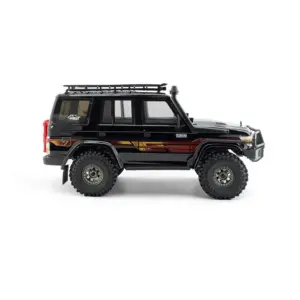
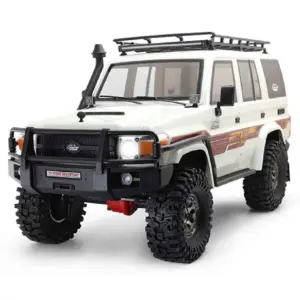
The RGT Pioneer has been RCUK’s top-selling 1:10 crawler for years because it gets the fundamentals right at a price where most competitors are cutting corners. Proper solid axles, oil-filled shocks, and a metal drive shaft where cheaper crawlers use plastic. The tyres are usable out of the box and the chassis accepts most popular aftermarket upgrades. At £170 it’s the one we’d recommend as a first crawler for anyone who wants to see if the discipline is for them.
RGT 18000 Rc Car 1:10 4wd Off Road Rock Crawler 4×4View product →
2. Axial SCX10 III — the standard bearer
Scale: 1:10 | Drive: 4WD with locked diffs | Motor: brushed | Approx price: £350-£400
Axial’s SCX10 series is what other crawlers are compared against. The III is the current generation — a step up in build quality, articulation, and detail over the RGT Pioneer, and the aftermarket support is immense. If you’re committing to crawling as a long-term hobby, the SCX10 III is the chassis you’ll want to grow into.
3. HBX 1:24 Devastator — best micro crawler
Scale: 1:24 | Drive: 4WD | Motor: brushed | Approx price: £80
For indoor crawling or very tight gardens, a 1:24 micro crawler delivers surprisingly convincing scale driving on a budget. The HBX Devastator comes with two batteries, a USB charger, and a fully waterproof drivetrain in a chassis the size of a paperback. Perfect for introducing the hobby to children or for driving on indoor courses made from books, cushions and water bottles.
4. FMS FCX24 Power Wagon — best scale-detail 1:24
Scale: 1:24 | Drive: 4WD with portal axles | Motor: brushed | Approx price: £170
FMS has become a go-to for anyone who wants scale detail without stepping up to 1:10. The FCX24 platform uses real portal axles, a three-speed transmission, and licensed scale bodies — the Power Wagon looks genuinely convincing on a garden course. More expensive than the HBX Devastator but a step up in mechanical detail.
5. FTX Outback Kingpin — best-value 1:10 scale trail truck
Scale: 1:10 | Drive: 4WD | Motor: brushed | Approx price: £200
The FTX Outback series sits between the RGT Pioneer and the SCX10 III on build quality, with scale detail that beats both at the price. Full waterproof electronics as standard, good tyres out of the box, and a reputation for reliability that’s earned over several years of steady sales. Great second-purchase crawler after a sub-£100 1:24 starter.
6. Element RC Enduro — best for trail events and competition
Scale: 1:10 | Drive: 4WD with locked diffs, portal axles on some variants | Motor: brushed | Approx price: £430-£500
If you’re going to competitive trail events, the Element RC Enduro is the serious driver’s pick. Long wheelbase, portal axles on several variants, outstanding articulation, and a chassis designed specifically for timed trail competitions. It’s not the first crawler you buy — it’s the one you work up to.
Quick comparison
| Model | Scale | Drive | Best for | ~Price |
|---|---|---|---|---|
| RGT Pioneer | 1:10 | 4WD locked | First 1:10 crawler | £170 |
| Axial SCX10 III | 1:10 | 4WD locked | Long-term platform | £400 |
| HBX 1:24 Devastator | 1:24 | 4WD | Indoor, budget starter | £80 |
| FMS FCX24 Power Wagon | 1:24 | 4WD portal | Scale detail, micro | £170 |
| FTX Outback Kingpin | 1:10 | 4WD | Value scale trail | £200 |
| Element RC Enduro | 1:10 | 4WD | Trail competition | £450 |
What else do you need for crawling?
Unlike buggy or touring-car driving, crawling is low-stress on tyres and relatively gentle on the chassis, so long-term running costs are among the lowest in RC. What you’ll want:
- A second battery — a crawling session often stretches to 2-3 hours; runtime per pack is 40-60 minutes at crawler speeds but that’s still not enough for a full afternoon. Browse RC batteries.
- A high-torque steering servo — the servos shipped in sub-£200 crawlers are usable but weak. An upgrade servo gives you more steering lock under load, which is what you need on a steep incline.
- Spare tyres — softer compounds wear faster than you’d expect on rough terrain. A spare pair of crawler tyres in a grippier compound transforms a stock RTR.
- A pressurised water bottle or brush — for cleaning mud and grit out of the chassis after each session. Crawling kit gets dirtier than any other RC discipline.
Where to crawl in the UK
Crawling works almost anywhere with varied terrain. Good venues include:
- Woodland car parks and the tree line at the edge of parks (with permission).
- Beaches at low tide — rocks and pools make for excellent technical driving.
- Canal towpaths (non-peak hours, and mind walkers).
- Indoor courses — at home or at a local RC club.
- Dedicated trail and crawl events — check our UK RC club and track finder.
Frequently asked questions
What’s the best RC crawler under £100?
At the sub-£100 price point, 1:24 micro crawlers dominate. The HBX Devastator at ~£80 is our top pick for value, with full 4WD drivetrain, two batteries, and a USB charger in the box. Expect to compromise on scale detail and tyre quality at this price.
Is a brushless motor worth it on a crawler?
Not usually. Crawlers benefit from high-torque low-turn brushed motors, not the high-RPM characteristic of brushless. Competition comp-crawler drivers use specific brushless sensored motors tuned for low-speed torque, but that’s a specialist upgrade — 95% of crawler drivers are happier with brushed.
Do I need waterproof electronics?
Yes. Crawling involves stream crossings, wet grass, mud, and sometimes snow. All modern RTR crawlers ship with waterproof ESCs and receivers — confirm “waterproof” or “sealed” in the specification before buying. Older second-hand crawlers may have exposed electronics that need sealing.
What’s the difference between a trail truck and a comp crawler?
Trail trucks prioritise scale looks and realistic driving: full bodies, hard panels, slower throttle response, and scale-appropriate articulation. Comp crawlers strip the scale detail to save weight and maximise articulation for technical courses — they often look more like chassis-with-wheels than cars.
Can I drive a crawler on tarmac?
You can, but you’ll wear out the tyres fast and find the low gearing frustrating. Crawlers are happiest on rock, dirt, wet grass, wood chips, and indoor padded courses. Use a separate car for tarmac driving.
How fast does an RC crawler go?
Top speed is typically 5-15 mph. Fast for a crawler is “walking pace on flat ground”. The joy of crawling is technical terrain, not speed.
Do crawlers need special batteries?
No, standard RC LiPo or NiMH packs work fine. 2S or 3S LiPo in 3000-5000 mAh is the usual choice for a 1:10; 2S 1200-2000 mAh for a 1:24. Lower C-rate packs are fine — crawlers don’t draw the peak current a buggy does.
Which crawler brand has the best UK parts availability?
Axial (for SCX10 platforms) has the deepest aftermarket, followed by RGT and FMS for their respective platforms. Our spare parts catalogue covers all six models on this list.
Shop RC crawlers in stock at RCUK
Summary
If you’re buying your first crawler, the RGT Pioneer at ~£170 is the sensible default. For indoor and budget use, go with the HBX Devastator 1:24. If you’re committed to the hobby and want a long-term chassis with huge aftermarket support, start with the Axial SCX10 III. Crawlers aren’t the fastest RCs, but they’re quietly the most satisfying — and once you’ve spent an afternoon climbing rocks and logs, few other disciplines feel as absorbing.
Independent, UK-focused guides to every kind of RC car, plane and helicopter — browse all RC buying guides →