
Best beginner RC helicopter UK — coaxial, fixed-pitch and collective-pitch
RC helicopters have a reputation for being the hardest RC discipline to pick up — and that reputation was earned in the early 2000s, when a new driver needed 20 hours of simulator practice before a real helicopter would stay airborne for more than a few seconds. Modern beginner helicopters have closed the gap dramatically. A 6-axis gyro-stabilised coaxial or fixed-pitch machine will hover from the first flight, and you can build skill gradually without crashing £200 worth of carbon fibre in the first minute.
This guide is for anyone considering their first RC helicopter: what to buy, how much to spend, and what to expect in the first hour of flight.
Three kinds of beginner RC helicopter
Before the shopping list, understand the three configurations you’re choosing between. Each has a very different learning curve.
Coaxial
Two counter-rotating main rotors stacked vertically. The upper rotor cancels the torque of the lower, so the helicopter sits in a hover with minimal input. No tail rotor is needed — yaw is controlled by varying the relative speeds of the two main rotors. Coaxials are the safest starting point: they’ll hover in place with the sticks at centre, they self-correct small disturbances, and they survive low-altitude crashes well.
Trade-off: they’re slow, limited in wind tolerance (don’t fly outdoors in more than a light breeze), and lack the handling characteristics of a real single-rotor helicopter. Coaxials are the right first purchase, but most drivers outgrow them.
Fixed-pitch (single-rotor)
One main rotor with blades at a fixed angle. Lift is controlled by varying motor RPM. Cheaper and simpler than collective-pitch, more realistic to fly than coaxial, and fast enough to be genuinely exciting outdoors.
Fixed-pitch with a decent gyro and 6-axis flight stabilisation has become the sweet spot for learning. Flight time is typically 6-10 minutes on a single battery, indoor operation is possible with micro variants, and outdoor flight in calm conditions is accessible from the first session.
Collective-pitch (CP)
The blade angle changes during flight — collective pitch for lift, cyclic pitch for direction, plus a tail rotor for yaw. This is the configuration used in full-size helicopters. A good CP heli flies like a real helicopter: it can climb, descend, invert, and hover with precision.
CP helicopters are not beginner machines. They’re unforgiving — the first few seconds of bad input will put it on the ground. CP is where the hobby goes once you have 20+ hours on coaxial or fixed-pitch, and it’s where 3D aerobatics live.
The shortlist — 6 beginner RC helicopters for 2026
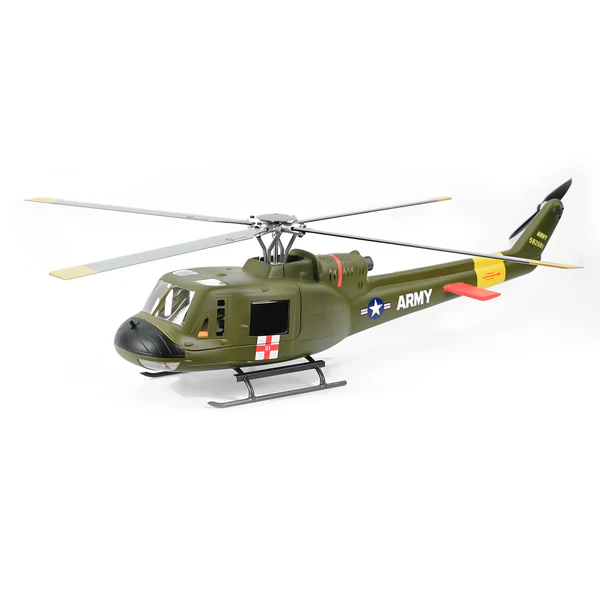
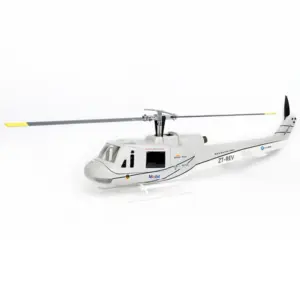
1. Flywing UH-1 Huey — best scale coaxial for indoor
Type: Coaxial | Flight time: 6-8 min | Indoor capable: Yes | Approx price: £100
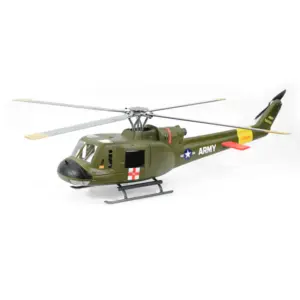
A surprisingly convincing 1:32 Huey in coaxial form, with scale detail that makes it a display piece as well as a learning machine. Stable enough for genuine first-flight hovering in the living room, slow enough that a bad input doesn’t end the flight. Flywing’s reputation for scale helis is well earned — this is where they shine.
Flywing Huey V4 RC helicopter Ready-to-flyView product →
2. Flywing Airwolf RC Helicopter RTF — best scale beginner fixed-pitch
Type: Fixed-pitch | Flight time: 7-10 min | Indoor capable: Marginal | Approx price: £230
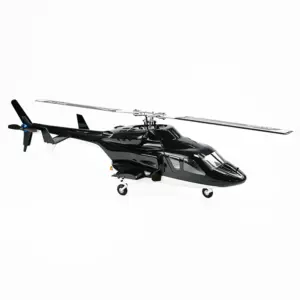
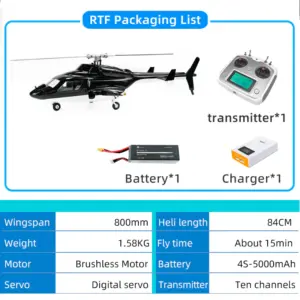
The Flywing Airwolf is the bestseller in our scale heli range, and for good reason. 6-axis flight controller with stability-assist for beginners, switchable to sports mode as skills develop. The Airwolf body is iconic, the build quality feels premium, and it’s the right pick for someone who’s drawn to the hobby by the scale realism rather than the acrobatics.
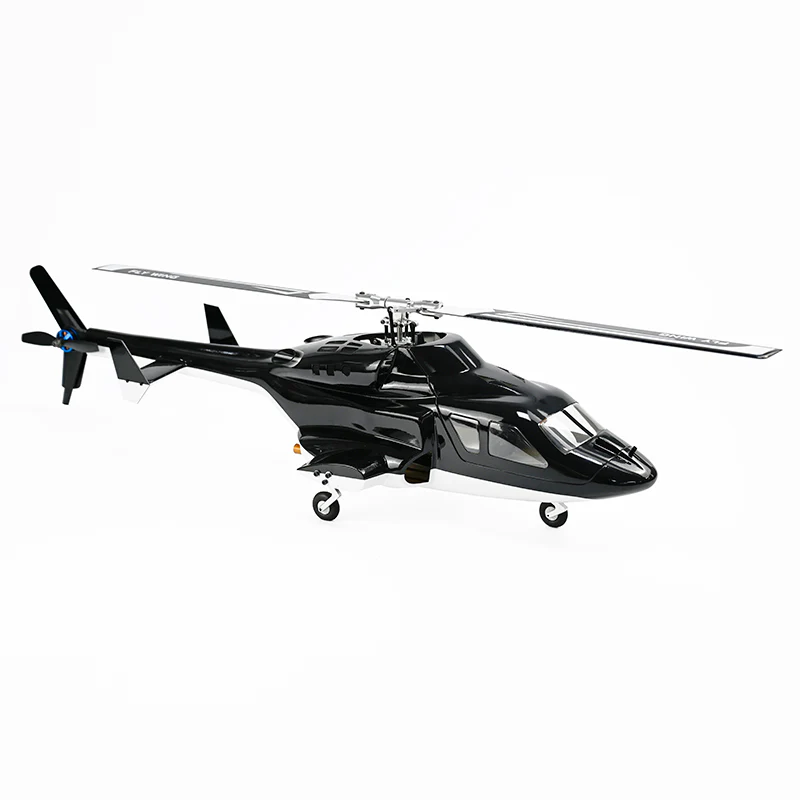 Flywing Airwolf V2 RC Helicopter with gyro RTFView details →
3. Flish RC FL500 V2 Cobra — the “serious” beginner helicopter
Type: Fixed-pitch scale (500-size) | Flight time: 8-12 min | Indoor capable: No (too large) | Approx price: £370
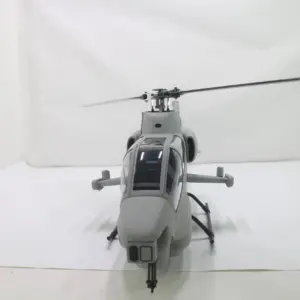
The Flish RC FL500 V2 Cobra steps up to a proper 500-size scale helicopter — the same size class used in casual 3D flying. With 6-axis stabilisation and a Cobra fuselage, it’s large enough to handle UK wind conditions but still forgiving enough to learn on. If you know you’re going to stick with the hobby, this is a chassis you’ll fly for years.
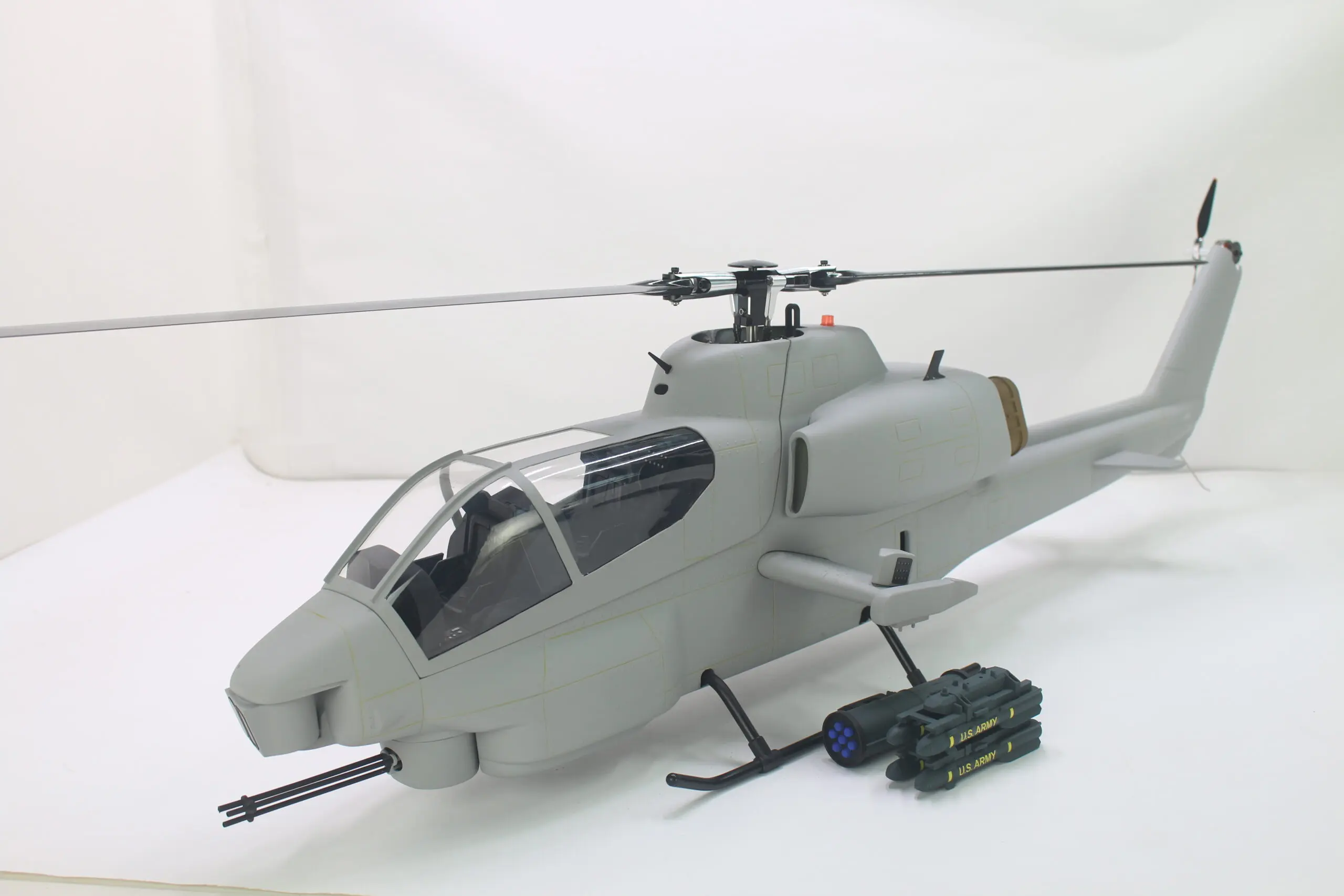 FLISHRC FL500 V2 FLISHRC 500 AH-1 Cobra 500 Size Scale Helicopter GPS RTFView product →
4. Eachine E120S Coaxial — budget coaxial indoor pick
Type: Coaxial | Flight time: 5-7 min | Indoor capable: Yes | Approx price: £60
The cheapest way into a hobby-grade coaxial that isn’t toy-grade. Full 4-channel control, USB charger in the box, and a design small enough to fly in a hallway. Flies for roughly 5-7 minutes per charge. Great stocking filler for a teen or adult wanting to see whether the hobby is for them before spending £200+.
5. Blade 230 S V2 — best learner collective-pitch
Type: Collective-pitch | Flight time: 5-8 min | Indoor capable: Marginal | Approx price: £380
If you’re approaching helicopters having already done drones or RC planes, a 230 S V2 from Blade gives you a genuine collective-pitch platform with the manufacturer’s SAFE flight-assist software. SAFE mode levels the heli when you release sticks; turn it off once you’re ready for 3D. This is a faster learning path for drivers who already have airborne RC experience.
6. Omphobby M2 V2 — best all-round hobby-grade fixed-pitch
Type: Fixed-pitch | Flight time: 8-10 min | Indoor capable: Yes | Approx price: £280
Indoor-friendly size, outstanding stability, and the right balance between beginner-forgiving and responsive-enough-to-grow-with. The M2 V2 has a devoted following among indoor micro pilots. Consider this if you want one helicopter that covers everything from your first hover to low-rate aerobatics.
Comparison
| Model | Type | Indoor | Flight time | Best for | ~Price |
|---|---|---|---|---|---|
| Flywing Huey coaxial | Coaxial | Yes | 6-8 min | Scale indoor starter | £100 |
| Flywing Airwolf RTF | Fixed-pitch | Marginal | 7-10 min | Scale outdoor starter | £230 |
| Flish RC FL500 V2 Cobra | Fixed-pitch scale | No | 8-12 min | Serious outdoor heli | £370 |
| Eachine E120S | Coaxial | Yes | 5-7 min | Budget taste-tester | £60 |
| Blade 230 S V2 | Collective-pitch | Marginal | 5-8 min | Experienced RC pilot | £380 |
| Omphobby M2 V2 | Fixed-pitch | Yes | 8-10 min | All-round hobby-grade | £280 |
First-hour learning plan
Your first session with an RC helicopter should follow this order. Skipping steps costs you a rotor blade, usually.
- Read the manual. Seriously. Helicopters have idle-up modes, trim controls, beginner/intermediate/expert flight modes. Fly on beginner mode first.
- Indoor first. Even outdoor-capable helicopters should have their first 2-3 flights indoors or in a sheltered garden. No wind, no uneven ground, no distractions.
- Hover over a cushion. Ease the throttle up until the heli leaves the ground by an inch or two, then back off. Repeat 10-15 times. Get comfortable with the weight of the throttle stick before you try anything else.
- Hover at knee height. Once ground-hover feels controllable, go to 2-3 feet and hold position. This is where the first bit of real flight skill develops.
- Short forward flights. 2-3 feet of cyclic forward, let it drift, cyclic back. Start with the rotor disc almost flat — fast forward flight comes weeks later.
- Stop when you’re tired. Most crashes happen in the last minute of flight time, when the battery’s near empty and you’ve been concentrating for 10 minutes straight. Land, change battery, come back in 20 minutes.
What to buy alongside your first helicopter
- A second battery. Flight times are short. A single pack gives you 6-10 minutes of actual flight; two packs turn a single visit to a flying field into a real session.
- A training aid (coaxial only). A training undercarriage — two crossed rods with ping-pong balls at the ends — stops tip-over crashes in the first 10 flights. Roughly £15 or home-made.
- Spare rotor blades. Break them; you will.
- A simulator. PhoenixRC, RealFlight or the free HeliX simulator if your transmitter supports USB dongle output. Ten hours of simulator time is cheaper than one crashed main rotor.
UK rules and flying locations
RC helicopters under 250 g require no CAA registration. Over 250 g (which covers most of this list) you need to register with the CAA and pass the free online Flyer ID test, renewed annually.
Fly below 120 m (400 ft), within visual line of sight, and 50 m from uninvolved people. Most UK RC clubs welcome helicopters at their flying fields; indoor venues include sports halls and some community centres. Our UK RC club and track finder lists clubs with helicopter-friendly facilities.
Frequently asked questions
Is an RC helicopter harder than a drone?
Yes, substantially. A modern quadcopter flies itself — GPS hold, altitude hold, and return-to-home are standard. An RC helicopter requires continuous input to stay airborne and responds to rotor-wash, ground effect and wind in ways a drone does not. That said, modern stabilisation has made RC helicopters far more accessible than they were a decade ago.
How long do RC helicopters fly on one battery?
6-10 minutes for most electric beginner helis. Larger scale helis manage 8-12 minutes. Nitro and turbine helicopters run 10-15 minutes on a tank.
Should my first helicopter be coaxial or fixed-pitch?
Coaxial if you’re slightly nervous about flying or if you want a very low-risk first experience, particularly indoors. Fixed-pitch with a gyro if you’re confident and want a platform you’ll grow with. Skip collective-pitch as a first purchase unless you’re already experienced with other RC aircraft.
Can I fly an RC helicopter indoors?
Small coaxial and micro fixed-pitch helicopters (under 200 mm rotor diameter) are designed for indoor flying. Anything larger needs a sports hall or outdoor space. Check the spec for “indoor flying” before assuming a heli will work in the living room.
How much does a good beginner RC helicopter cost?
£60-£100 for an entry-level hobby-grade coaxial. £200-£300 for a serious fixed-pitch beginner. £300-£500 for a scale beginner with room to grow. Spending less than £40 almost always buys toy-grade, which is frustrating to fly and not repairable.
Do I need a transmitter licence for UK helicopter flying?
No licence is needed to operate a 2.4 GHz RC helicopter. If the aircraft weighs 250 g or more, you need to register with the CAA and pass the free Flyer ID online test. No practical assessment is required for club or private flying.
How long does it take to learn to fly an RC helicopter?
Stable hover from the first flight on a modern beginner coaxial. Confident hover and basic forward flight in 5-10 sessions. Precise aerobatic flight takes months to years, depending on how much you fly. A flight simulator accelerates all of this considerably.
Can I crash an RC helicopter badly?
You can. A hard crash can bend the main shaft, break the rotor head, damage the swashplate, or snap the boom. Budget £30-£60 for spare parts across your first year. Good beginner helicopters have rotor blades that snap on impact, which protects more expensive components from damage.
Shop RC helicopters at RCUK


Summary
For most first-time RC helicopter buyers, the Eachine E120S coaxial at ~£60 is the smart taster. If you’re confident you want more, step to the Flywing Airwolf at ~£230 for scale flying outdoors, or the Omphobby M2 V2 at ~£280 for a do-everything fixed-pitch that works indoors and out. Serious beginners with experience of drones or planes can skip straight to the Blade 230 S V2 for a real collective-pitch learning platform.
Whichever you choose: hover indoors first, buy a spare battery, and invest ten hours in a simulator. The hobby rewards patience more than any other.
Independent, UK-focused guides to every kind of RC car, plane and helicopter — browse all RC buying guides →